These days, it is much easier for the Ukrainian community to find a partner than it is to turn that partnership into tangible results.
Local authorities are actively building networks of cooperation both within the country and abroad. Against a backdrop of war, limited local budgets and vast reconstruction needs, international and inter-municipal partnerships have become one of the key tools for attracting resources, expertise and investment.
However, there is still a gap between the number of agreements signed and the number of projects implemented.
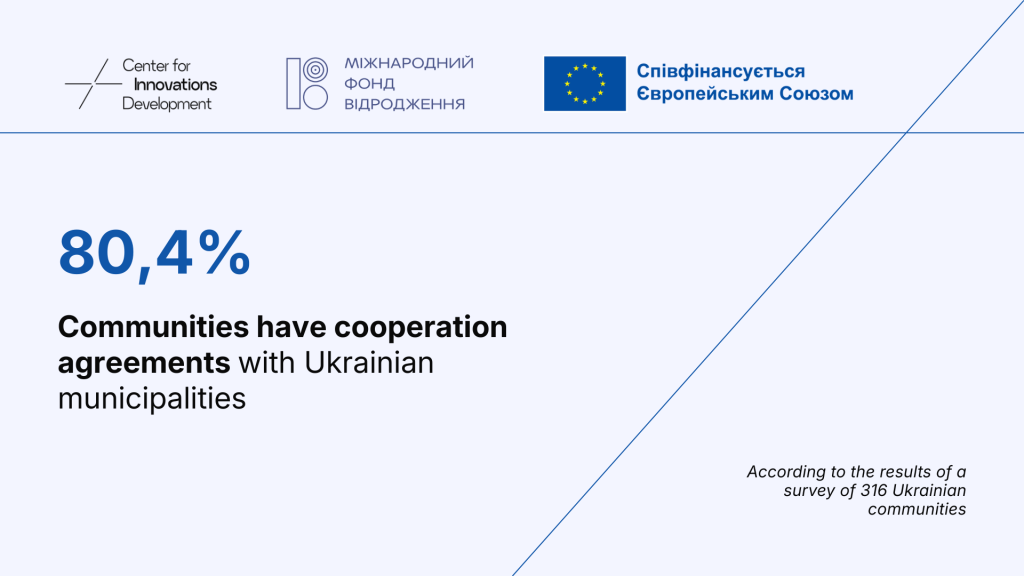
According to the findings of a study carried out by analysts at the Centre for Innovation Development amongst 316 local authorities, over 80 per cent (specifically 80.4 per cent) of local authorities have cooperation agreements with other Ukrainian local authorities, and more than half have established partnerships with European municipalities. At the same time, only 28% of the communities surveyed reported having implemented joint projects with European partners.
This figure highlights one of the characteristics of the development of local self-government – it is much easier to sign an agreement than to build an effective partnership.
Partnerships have become part of a new model for community development
Just a few years ago, inter-municipal cooperation was often seen as an additional activity that had no direct impact on community development. Today, the situation has changed.
Communities are seeking partners to modernise their infrastructure, develop educational and healthcare services, attract international aid, promote economic development and prepare for future reconstruction.
In our dealings with representatives of local government, it is becoming increasingly apparent that a new culture of governance is taking shape. Communities are beginning to operate not only within their own administrative boundaries, but also through networks of cooperation and shared interests.
The results recorded during the study by analysts at the Centre for Innovation Development are particularly telling. For example, the Novograd-Volynskyi community in Zhytomyr Oblast has cooperation agreements with 26 partners. The Pokrovska community in Dnipropetrovsk Oblast cooperates with 13 communities, whilst the Brusylivska community in Zhytomyr Oblast cooperates with 11. The Pervomaiska community in Mykolaiv Oblast and the Okhtyrska community in Sumy Oblast each have ten partners.
At first glance, such figures might suggest a high level of international and inter-municipal activity. However, the sheer number of documents signed does not in itself indicate the quality of the cooperation.
The signed memoranda of understanding open up opportunities for partnership. Results are only achieved when these are followed by joint projects, the exchange of expertise, the mobilisation of funding and the resolution of specific community issues.
Why do some partnerships work, whilst others never get off the ground?
A study by the Centre for Innovation Development has shown that the most successful communities are those that view partnership not as a one-off option, but as an ongoing area of work.
Indeed, in the Trostyanets community in the Sumy region, cooperation with Chortkiv, Dolyna and Zhovkva has gone far beyond mere declarations. The communities have organised joint cultural events, exchanged humanitarian aid and collaborated on the restoration of war-damaged facilities.
The Khotyn community in the Chernivtsi region has 22 international partners in ten countries. Representatives of the community regularly take part in international forums, are active in European networks of municipalities, and a dedicated specialist oversees matters relating to international cooperation.
Thanks to international partnerships, the Rivne community has implemented a number of infrastructure projects in the fields of water treatment, sewerage, healthcare, the environment and civil protection.
A common pattern can be seen in these examples. Successful partnerships arise where there is a systematic approach, clearly defined points of contact and a long-term vision for the development of the collaboration.
Conversely, where a partnership ends with the signing of a document, its potential often remains untapped.
The main challenge is not finding a partner, but bringing the project to fruition
Many communities face difficulties even after establishing contacts.
To implement a joint project, agreements between the parties are not enough. It is necessary to prepare a high-quality project proposal, identify sources of funding, secure co-financing, maintain constant communication between partners, and meet the requirements of donor programmes.
For small communities, this is a challenging task. Often, international activities are not a separate area of work, and a single staff member is responsible for investments, grant applications, the budgetary process and international cooperation all at once.
This is precisely why many communities today have partners but do not always have sufficient human and organisational resources to fully realise the potential of these partnerships. As a result, the number of agreements is growing faster than the number of projects actually implemented.
Local people are becoming just as important as partners
Bill No. 10284, which was recently passed by the Verkhovna Rada, is intended to partially resolve the issue.
The bill introduces a mechanism for providing additional payments to local government officials involved in the preparation and implementation of international technical assistance and international territorial cooperation programmes. Such allowances may be funded through grants, international aid and funds from partnership programmes.
In effect, the state is now recognising what communities have been saying for many years: international partnerships require not only political will and signed agreements, but also professional specialists who can oversee projects from the initial application through to full implementation.
At the same time, the law alone will not solve all the problems. It creates incentives for developing the human resource capacity of local communities, but the effectiveness of partnerships will continue to depend on the extent to which local authorities systematically develop project management, international communication and engagement with donors.
Reconstruction will require a new level of partnership
In the coming years, international and inter-municipal partnerships will remain one of the key resources for the development of Ukrainian communities. This is particularly true in the context of Ukraine’s large-scale reconstruction and its further integration into the European Union.
However, the main indicator of success should not be the number of memoranda signed. The true value of a partnership is measured by the projects implemented, the resources mobilised and the changes experienced by the community’s residents.
Today, Ukrainian communities have already learnt how to find partners. The next stage is to learn how to turn these partnerships into tangible development outcomes.
This study of partnerships between Ukrainian and European municipalities was carried out with the support of the European Union and the International Renaissance Foundation as part of the joint initiative ‘Joining the EU Together’. The content reflects the authors’ views and does not necessarily reflect the views of the European Union or the International Renaissance Foundation.
Kateryna Ivanchenko, Director of the Centre for Innovation Development, writing exclusively for “The Page“.