A new wave of business research by the Center for Innovations Development and Advanter Group, conducted in June 2026, offers an in-depth analysis of the current state of affairs.
The survey was conducted from June 8, 2026, to June 22, 2026. A total of 503 respondents – owners and managers of micro, small, and medium-sized enterprises – were surveyed.
Despite a slight improvement in the Business Activity Index (UBI), entrepreneurs’ expectations remain negative. Businesses continue to face a decline in activity, underutilized production capacity, rising costs, deteriorating profitability, and limited financial stability. Additional barriers to growth include labor shortages, lack of capital, weak effective demand, as well as regulatory and economic uncertainty.
The 25th wave of the SME survey captures these changes, assesses current business sentiment, and identifies key areas for development.
Business Activity Index (UBI)
The business activity index rose to 34,8 points out of a possible 100 in June 2026 (compared to 32,9 points in March 2026). Despite this positive trend, the index remains below 50 points, indicating negative business expectations. At the same time, the manufacturing sector (34,8 points) has practically caught up with the non-manufacturing sector (34,6 points), whereas in March its figure was significantly lower – 31,7 points.
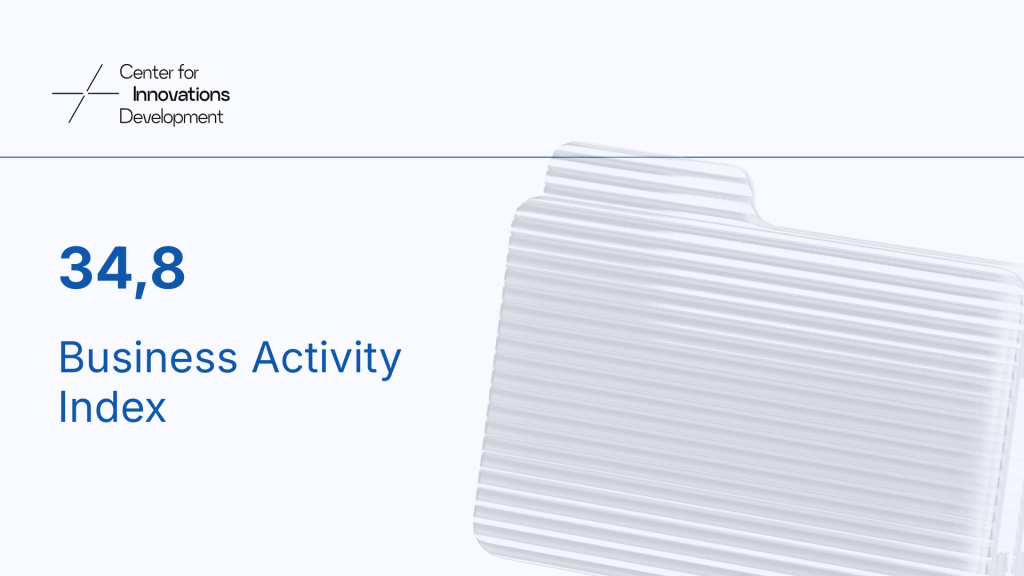
It should be noted that a UBI reading below 50 indicates that businesses have negative expectations regarding future developments.
Current Operations of Enterprises
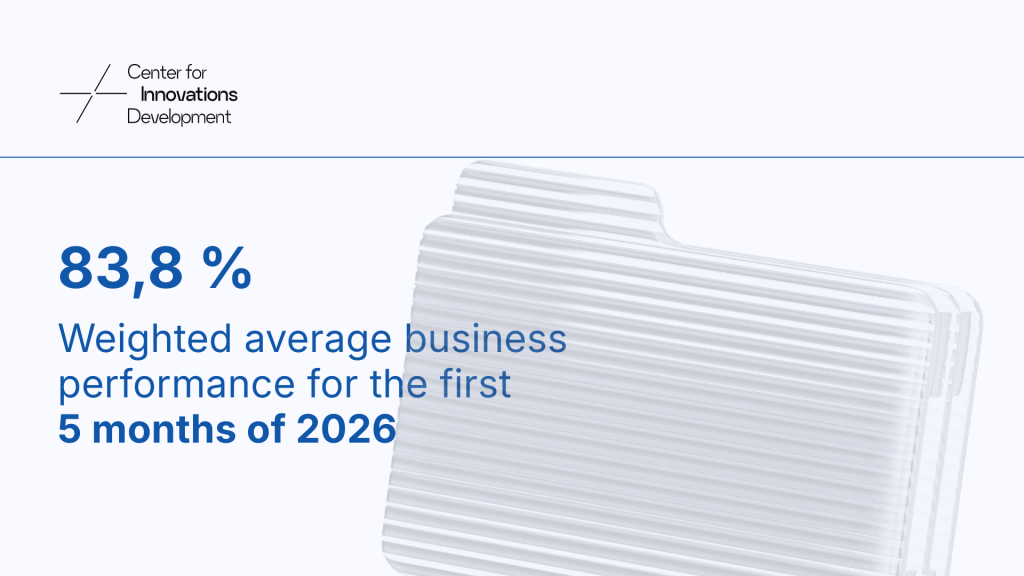
The first five months of 2026 remain challenging for businesses. The weighted average performance of companies stands at 83,8% of the level recorded during the same period in 2025. Nearly 60% of companies have reduced their business volume, while only 17,1% have managed to increase it. At the same time, businesses founded after 2022 are showing better results (94%) compared to companies established before 2014 (82%).
The average capacity utilization rate is only 61,9%. One in three companies (out of the 430 that were able to provide this figure) uses less than half of its capacity. Microbusinesses have the lowest capacity utilization rate (58,6%), while for small and medium-sized businesses, the rates are 63,5% and 64,6%, respectively.
Costs for micro, small, and medium-sized businesses: margins under pressure
85% of businesses have faced an increase in operating expenses—by an average of 19,1%. The largest increases were in utility costs (64,2% of responses), logistics and transportation (63,4%), payroll (60,4%), and raw materials and supplies (57,9%).
Labor costs rose by an average of 13,7% despite a decline in production volumes. The main reason is a labor shortage, which is having the greatest impact on medium-sized businesses. 92% of companies are feeling the pressure from rising costs. Despite price increases, 74,8% of businesses reported a decline in profitability. Among those that raised prices, 75,5% also saw a drop in profitability, and 13,7% became unprofitable.
The most common ways to cut costs are optimizing logistics and supply chains (46,9%), revising terms of cooperation with suppliers (31,6%), and investing in energy efficiency (23,3%). At the same time, 21,5% of companies are not taking any additional measures. Nearly half of businesses (45,5%) will be able to operate at their current level of operating expenses for less than six months. Only 14,3% have a financial buffer lasting more than a year.
Financial stability
The average rating for business financial stability is 2,66 out of 5. At the same time, 37% of companies rate their financial condition as unstable or critical. The risk of closure is almost independent of business size: the indicators for micro, small, and medium-sized businesses remain similar. A lower risk is observed only among large companies; however, the sample size is insufficient to draw representative conclusions.
Nearly 29% of businesses rate the likelihood of ceasing operations within the next 12 months as high or very high. Only 8,3% are considering expansion.
Access to finance
Effective demand remains the main market barrier: the weighted average estimate stands at 82,5% of the 2025 level. The difference between segments is small: microbusinesses at 82,2% of the 2025 level, small businesses at 83,3%, and medium-sized businesses at 82,8%.
Access to credit is available, but demand under market conditions is limited: 28,4% of businesses applied for a loan and received it. At the same time, 29% are unwilling to take out a loan at any interest rate, and the majority will only accept preferential terms (up to 10% per annum).
Key business challenges
The main barriers to business recovery and growth are unpredictable government decisions (56,5%), uncertainty regarding the situation in Ukraine (53,9%), a shortage of qualified personnel (50,5%), a lack of sufficient capital (47,5%), and a lack of a sufficient number of solvent customers (42.1%).
When interacting with government agencies, businesses most often encounter issues with tax invoices being blocked (19,9%), inspections by other government agencies (16,1%), and refusals to reserve conscripts (15,9%). The assessment of government agencies’ performance remains low: the State Tax Service (STS) scored 2.9 out of 5 (35,7% of those who had contact rated its performance as unsatisfactory or critically unsatisfactory; inspections and the blocking of invoices are the main complaints), and the State Migration Service (SMS) – 2,8 points (logistical delays at the border remain among the main problems).
A look ahead to 2027: risks and expectations
Respondents consider the most critical risks to business in 2026-2027 to be a further increase in operating costs (57.3%), an escalation of hostilities or new attacks on infrastructure (57,3%), a decline in effective demand (56.5%), and tax increases or changes to tax regulations (53,5%).
When asked what would have the greatest impact on the business climate in Ukraine in 2027, the overwhelming majority of respondents (86,9%) cited a ceasefire or peace negotiations. These were followed by tax system reform (47,9%) and attracting international investment for reconstruction (47,7%).
The study was prepared by the Center for Innovation Development in collaboration with Advanter Group, the Office for Entrepreneurship and Export Development, and the national project “Diya.” Business, with the support of the Ministry of Digital Transformation of Ukraine, the Ministry of Economy and Environment of Ukraine, and the Coalition of Business Communities for the Modernization of Ukraine, as part of the Initiative for Economic Recovery, Entrepreneurship, and Export Development in Ukraine.
The study uses data from the Pulse platform, which is implemented by the Ministry of Economy with support from BRDO as part of the “STEP IN 2 EU” international cooperation program, co-financed by the governments of Germany and Norway, as well as by the European Union under the EU4Business initiative with support from Deutsche Gesellschaft für Internationale Zusammenarbeit (GIZ) GmbH.