In the context of a full-scale war, Ukrainian territorial communities are facing unprecedented challenges in the area of governance. The need to respond quickly to the needs of the population, efficiently allocate limited resources and coordinate with international partners makes democratic participation of citizens in decision-making not only desirable, but also critical for the effective functioning of local self-government. The introduction of e-democracy tools is becoming a key mechanism for engaging residents in governance processes, ensuring transparency of decisions and improving communication between the authorities and the community. The prospects for post-war recovery require the development of reliable mechanisms of public participation that will ensure not only the legitimacy of the reconstruction processes, but also their compliance with the real needs of the residents. The international community’s trust in democratic procedures in Ukraine largely depends on the ability of communities to involve their residents in the planning and implementation of development projects.
The results of the second wave of the survey, conducted among 196 territorial communities from 24 regions, show a positive trend in the development of participatory democracy. The average participation rate across the country increased from 33.19% in 2023 to 36.91% in 2024, an increase of 3.72%. The best result among hromadas reaches almost 70%, which is a 12% increase compared to last year’s maximum of about 58%. But despite the positive changes, the study reveals a structural imbalance: communities are actively implementing participatory tools(57.05% on average), but the level of actual involvement of residents remains critically low – less than 5% on average.
In order to assess the state of involvement of residents in the processes of recovery and development in territorial communities, the Centre for Innovations Development initiated the development of the Participation Indicator together with the DREAM Project Office.
The key goals and values that form the indicator are:
- assessment of the level of democratic and inclusive decision-making;
- an indicator of effective decision-making in the community based on the needs of residents;
- increasing the level of trust in the community recovery process among the international community and Ukrainians;
- facilitating the involvement of all stakeholders in the reconstruction process, including project development and discussion;
- an opportunity to assess the level of participatory democracy in the community in comparison with others, share experiences and implement best practices of engagement.
The participation indicator in territorial communities is based on the assessment of three key blocks: participation tools, the level of involvement of residents, and participation in the reconstruction process. The final indicator is calculated as an arithmetic average of the three blocks with a maximum of 100%. The second wave also collected data on community participation in shaping public investment project (PIP) policies as of 2024.
According to the results of the first wave of the study, the average participation rate in Ukraine in 2023 was 33.18%. This is a rather low result, which indicates a significant potential for developing resident engagement. When broken down by territorial communities, the highest participation rate was about 58%, and the lowest was about 13% among the communities that took part in the study.
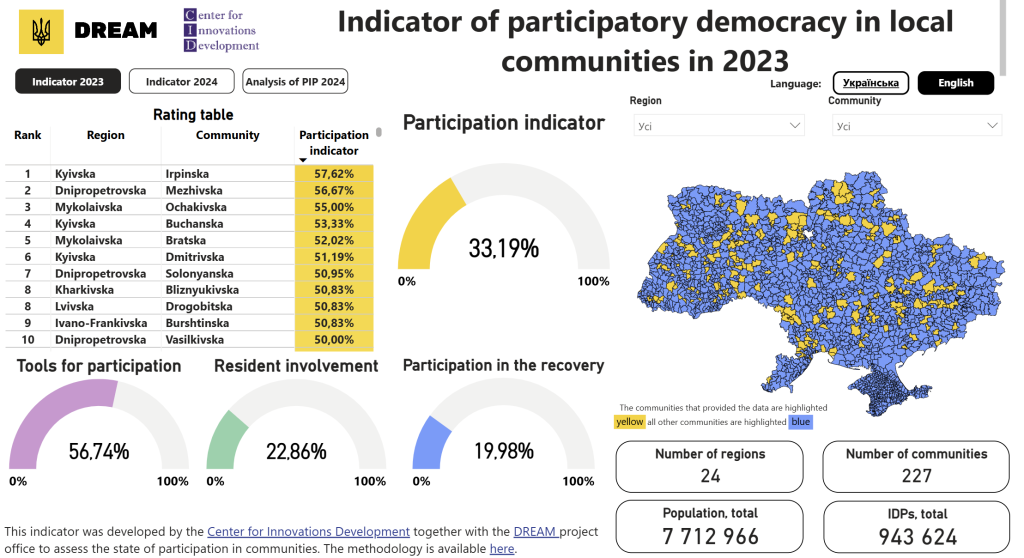
During the second wave of the study, 196 territorial communities from 24 oblasts provided data for the Participatory Democracy Index for 2024, including those near the frontline and those in the occupied territories. We emphasise that if your community wants to provide data to be displayed on the dashboard, please contact us by email: [email protected].
The analysis of 2024 data shows an improvement in the level of development of participatory democracy in Ukrainian territorial communities compared to 2023. The average participation rate in the country is 36.91%, an increase of 3.72% over the previous year(33.19% in 2023). The highest rate was recorded in the territorial communities – almost 70% out of 100%. Compared to the previous year, the figure for communities increased by almost 12%. In general, it can be said that most communities have crossed the 30% mark in terms of participation, which indicates a tendency towards an increase in the level of participatory democracy in communities. This result demonstrates that Ukrainian communities are at the stage of active development of participatory democracy, but need systemic support to achieve higher results of citizen engagement in local self-government.
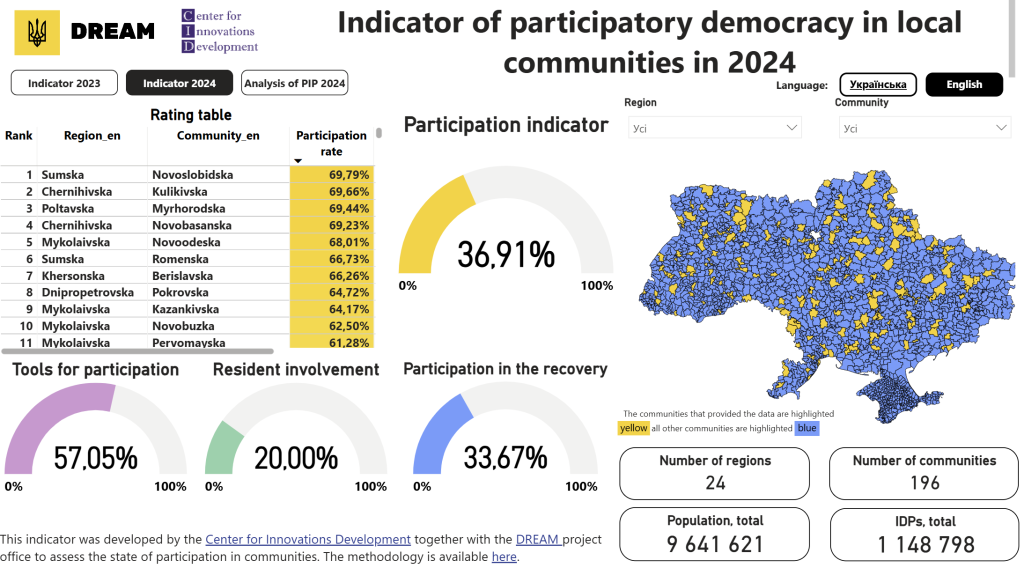
Among the communities that provided data, the top 5 communities can be distinguished by the aggregate participatory democracy indicator:
- Novoslobidska territorial community of Sumy region – 69.79 per cent
- Kulykivska territorial community of Chernihiv region – 69.66 per cent
- Myrhorod territorial community of Poltava region – 69.44 per cent
- Novobasanska territorial community of the Chernihiv region – 69.23 per cent
- Novodeska territorial community of the Mykolaiv Oblast – 68.01 per cent
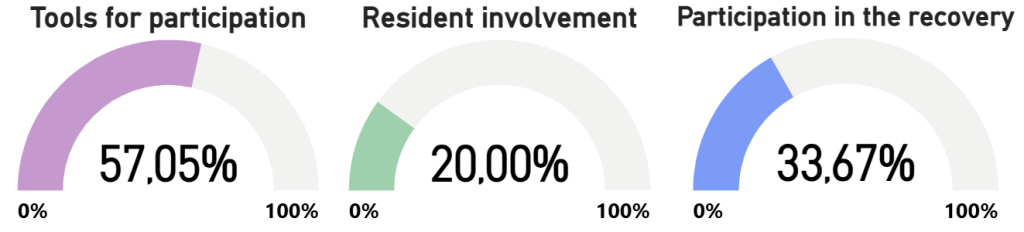
The Participation Instruments block demonstrates the highest results among the three components of the indicator – an average of 57.05%. The assessment was carried out for more than 20 participation tools, with the obligatory consideration of electronic participation formats and available digital solutions. This means that most of the surveyed communities have implemented basic mechanisms for engaging residents, including petitions, appeals, requests for public information, surveys of residents, etc. However, it was found that participatory budgeting, as one of the most effective tools of public participation, is currently underutilised.
The lowest result was shown by the Residents’ Involvement block – only 20.00%. This is a critical indicator that demonstrates the gap between the availability of tools and their actual use by citizens.
According to the methodology, the assessment was carried out on a scale:
- up to 5% of the population – 20% for evaluation
- 5-10% of the population – 40% for assessment
- 10-20% of the population – 60% for assessment
- 20-40% of the population – 80% for evaluation
- more than 40% of the population – 100% for assessment
The low score indicates that in most communities, only about 5% of residents actively use participation tools, which indicates the need to improve information and motivation of citizens.
The Participation in Recovery indicator is 33.67%. This block includes: the availability of a Community Development Strategy, the availability of a Comprehensive Recovery Programme, public discussions of recovery projects, and the collection of ideas from residents and NGOs. There is a significant gap between the leaders of the ranking – communities that have approved strategic documents and have engaged residents in discussions and gathering ideas – and those that do not currently have approved strategic documents necessary for recovery.
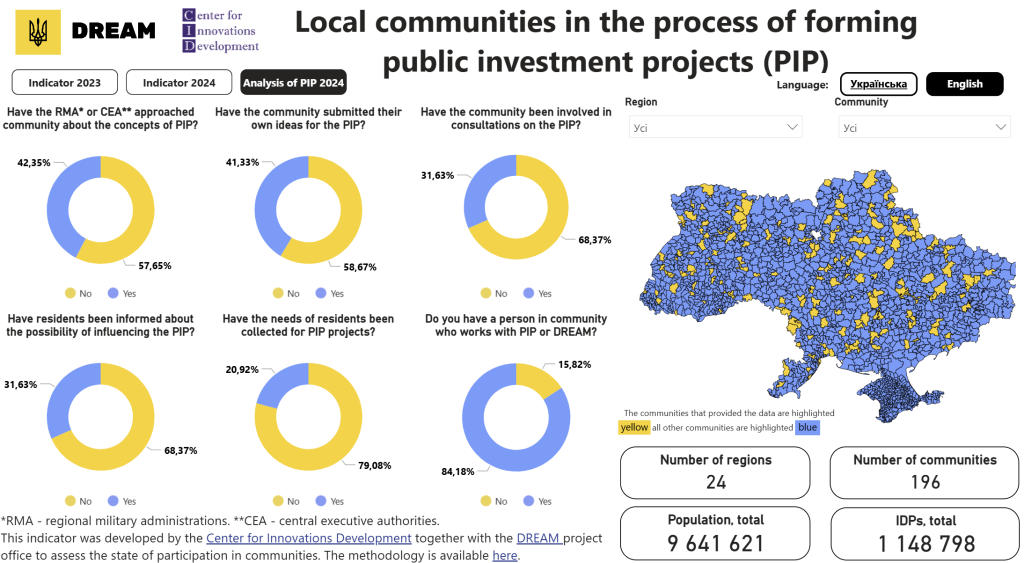
The 2024 study of the participation of territorial communities in shaping the policies of public investment projects reveals a significant gap between the organisational capacities of communities and the actual involvement of residents in the decision-making process. The majority of communities(84.18%) have identified responsible persons for interaction on CIPs, which indicates institutional readiness for cooperation at the local government level.
The activity of communities in submitting their own proposals is also noticeable – 41.33 per cent of communities initiated ideas focused on critical infrastructure: water supply, shelters, restoration of educational and medical facilities, which reflects the priorities of wartime. At the same time, interaction with higher levels of government is quite active – 42.35 per cent of communities have received requests from regional and central authorities for CIP concepts.
However, the biggest problem remains the lack of involvement of residents in the process of project development. Only 20.92% of communities collected residents’ opinions on their needs when preparing proposals, and only 31.63% of communities informed the population about the possibilities of influencing the CIP. Consultations with community representatives were held with 31.63% of the surveyed communities, mostly in an offline format. This creates a situation where communities have organisational capacity and actively interact with the authorities, but decisions are often made without due consideration of the opinions and needs of the direct beneficiaries of future projects. The results indicate the need to strengthen mechanisms for public participation and systematic public information to ensure a more efficient and democratic process of formulating public investment projects.
Conclusions
The study reveals a structural imbalance between the technical readiness of communities for citizen participation and the actual level of public involvement. This indicates the lack of effectiveness of local government communication and the need to revise approaches to informing citizens.
The low level of public engagement may be due to a lack of feedback on the results of public participation or a lack of understanding of the mechanisms for influencing decision-making. This is especially critical in public investment planning processes, where the lack of consultation with beneficiaries can reduce the effectiveness of implemented projects.
Significant discrepancies between communities indicate uneven development of democratic practices across the country. Communities with lower scores need targeted methodological and technical support to develop institutional capacities in the area of citizen participation.
In the context of post-war reconstruction, this situation poses risks to the optimal use of resources and may affect the level of trust of international partners in democratic governance processes at the local level.
The main problem lies not in the technical improvement of existing tools, but in the need to develop effective mechanisms for motivating and demonstrating the practical results of public participation. This requires a comprehensive approach to developing a culture of participation and increasing the level of civic engagement.
You can read the dashboard HERE
Our contacts:
E-mail: [email protected]
Website: https://cid.center/
Facebook: https://www.facebook.com/cid.center