The Verkhovna Rada recently passed Bill No. 10284, which allows local authorities to pay additional remuneration to staff involved in the preparation and implementation of international projects, using funds from grant programmes and international technical assistance.
The law is intended to strengthen local communities’ capacity to work with international partners, as the lack of qualified staff and resources to manage projects has long been one of the most significant barriers to attracting external funding.
The severity of the problem is confirmed by the results of a study by the Centre for Innovation Development, carried out amongst 316 local communities. Despite a significant number of partnership agreements with EU municipalities and almost universal experience of working with international donors, most communities are still unable to move from declarative cooperation to the implementation of joint projects.
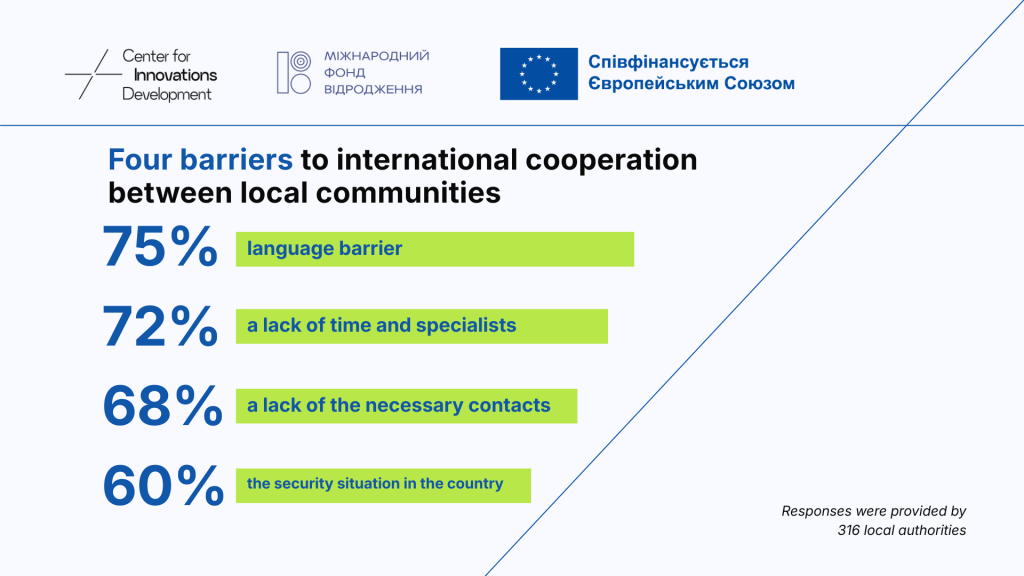
Research carried out by the Centre for Innovation Development has identified four key barriers that are currently hindering the development of international cooperation at local level.
Challenge No. 1: English remains the main obstacle
The language barrier has become the most common problem – 75% of the communities surveyed reported this issue. Local specialists often do not have a sufficient command of English to communicate with international partners, prepare project applications or work with European platforms.
A particular problem is the lack of in-house translators or international communications specialists within communities. Even modern machine translation tools do not always help when dealing with technical documentation or grant applications.
As a result, many opportunities remain out of reach right from the initial contact stage.
Challenge No. 2: One employee is responsible for everything
The second-largest obstacle was a shortage of staff. 72% of local authorities reported a lack of time and specialists to work with international partners.
In many local authorities, international activities are not a separate area of work. A single specialist is responsible for the budget, investments, project management, international relations and the preparation of reports all at the same time.
Under such circumstances, international partnerships are often sidelined in favour of day-to-day management tasks.
Challenge No. 3: Communities do not know where to look for partners
68% of the local authorities surveyed stated that they did not have a clear enough understanding of where exactly to find potential international partners.
Despite their willingness to cooperate, many local authorities do not know where to start when looking for twin towns or partners for joint projects. European cooperation platforms, directories of local authorities and partnership networks are often in English and remain largely inaccessible to smaller local authorities. In fact, communities lack a clear entry point into the international arena.
Challenge No. 4: War makes it harder to build trust
For 60% of communities, the security situation in Ukraine remains a major concern.
European partners are often wary of travelling to Ukraine due to the constant shelling and the risks posed by the conflict. At the same time, it is precisely these face-to-face meetings that often lay the foundations for long-term partnerships and joint projects. The lack of direct communication significantly slows down the process of building trust between municipalities.
Partnerships require more than just willingness. The research findings highlight an important trend: Ukrainian communities are already actively declaring their readiness for international cooperation; however, strengthening institutional capacity is needed to move from memoranda to actual projects.
It is not just a question of additional funding. Communities need training in international communication, the development of project management skills, access to partner networks, expert support in preparing grant applications, and practical tools for finding partners.
This study of partnerships between Ukrainian and European municipalities was carried out with the support of the European Union and the International Renaissance Foundation as part of the joint initiative ‘Joining the EU Together’. The content reflects the views of the authors and does not necessarily reflect the views of the European Union or the International Renaissance Foundation.
Kateryna Ivanchenko, Director of the Centre for Innovation Development, writing exclusively for the “Decentralisation” website.