Local authorities increased their spending on shelters in 2025, but a reduction in funding is planned for 2026.
This is demonstrated by the findings of a study into local authorities’ expenditure on the reconstruction and refurbishment of shelters in 2024–2026, which our organisation has been conducting for the second year running.
B 223 local authoritiesB took part in the survey, including B six regional centresB . The data is based on the authorities’ responses to questionnaires and information requests. Some city councils refused to provide information, citing the state of martial law; therefore, the figures given do not reflect the full picture across the country.
According to the local authorities surveyed, 1.5 billion UAH was allocated to shelters in 2024, rising to 2.9 billion UAH in 2025. At the same time, local authorities plan to reduce direct expenditure on shelters to 1 billion UAH in 2026. This will account for 0.9 per cent of total expenditure.
We analysed the Open Budget data separately, as this also takes into account grants and special funds. According to this data, total expenditure on shelter and security infrastructure is significantly higher:
- 96.9 billion UAH – in 2024;
- 107.1 billion UAH – in 2025;
- 111.5 billion UAH – as planned for 2026.
Thus, the data from the community surveys primarily show direct local expenditure, whilst Open Budget reflects a broader range of funding for security infrastructure.
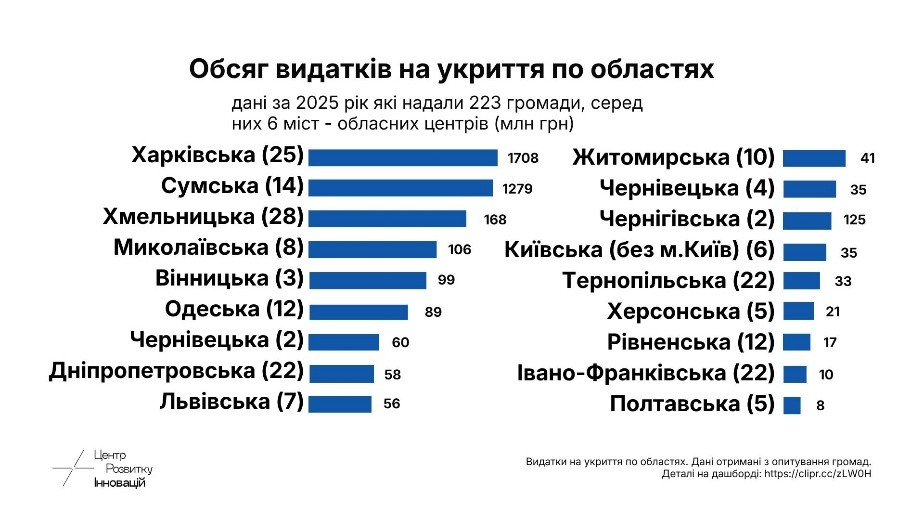
“When analysing security and defence expenditure as a whole, we focused specifically on spending on civil defence shelters as part of these security measures. Communities in the Kharkiv region took the lead: just 25 of the communities surveyed in this region allocated over 2.1 billion UAH for the period 2024–2026,” explains Olesya Malyavina, an analyst at the Centre for Policy Studies.
Second and third place in terms of funding are held by local authorities in the Sumy region – 939 млн грн – and the Khmelnytskyi region – 413 млн грн.
How are costs changing in regional centres?
The highest expenditure on shelter in 2025 was recorded in the regional centres. At the same time, some cities are already planning to cut spending for 2026.
Vinnytsia and Khmelnytskyi are among the leaders in terms of funding.
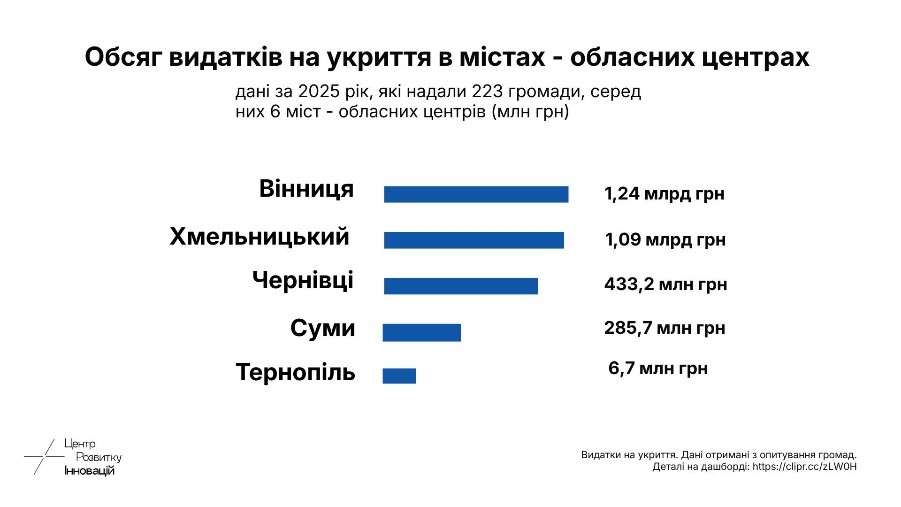
In Vinnytsia, 819.7 million UAH was allocated to shelters in 2024. In 2025, expenditure rose to 1.24 billion UAH. In its forecast for 2026, the city plans to reduce funding to 848.9 million UAH.
As early as 2024, Khmelnytskyi recorded one of the highest figures – 1.11 billion UAH. In 2025, the figure fell slightly to 1.09 billion UAH, and in 2026 the city plans to cut expenditure by almost half – to 523.1 million UAH.
The Financial Management Department of Khmelnytskyi City Council attributed the cut to a decline in the local authority’s financial capacity. According to officials, the additional burden was caused by pay rises for teaching staff and social services workers, as well as compensation for the difference in tariffs for heating and water supply companies, funded from the local budget.
At the same time, the city council emphasises that expenditure on shelters remains a priority and may be reviewed should the budget be exceeded.
Chernivtsi was the only city among those surveyed to show a steady increase in funding for shelters over all three years. In 2024, the city allocated 299.2 million UAH to these needs; in 2025, 433.2 million UAH; and in 2026, the figure is set to rise to 655.1 million UAH.
In Sumy, a city near the front line, funding in 2024 and 2025 remained almost unchanged: 285.6 million UAH and 285.7 million UAH respectively. In 2026, the city forecasts a reduction in expenditure to 70.4 million UAH.
In response to an enquiry, Ternopil City Council provided information on the level of expenditure for 2025. The figure is 6.7 million UAH.
In Zhytomyr, they refused to provide information in response to a request, citing the state of martial law.
Security costs have become a separate burden for local communities
The study by the Centre for Innovation Development covered not only the costs of shelter, but also a wider range of security-related expenditure. This includes funding for territorial defence programmes, grants for the defence forces, the reconstruction of facilities destroyed by missile strikes, as well as assistance for victims and internally displaced persons.
At national level, the State Budget of Ukraine for 2026 allocates 6 billion UAH to ensure safe conditions in educational establishments. Of this amount, 5 billion UAH will be allocated to general secondary education establishments and 1 billion UAH to pre-school education establishments.
The research data show that even in wartime, local authorities continue to invest in security infrastructure. At the same time, plans by some towns to cut funding in 2026 may indicate a growing budgetary burden on local government.
The summary results have been published on the analytical dashboard, which allows you to compare data by year (2024–2026) and by type of community.
Mykhailo Leichenko, Director of IT and Analytics at the Centre for Innovation Development, exclusively for LB.ua.